

How Automated Slide and Cassette Printing Improves Pathology Workflow
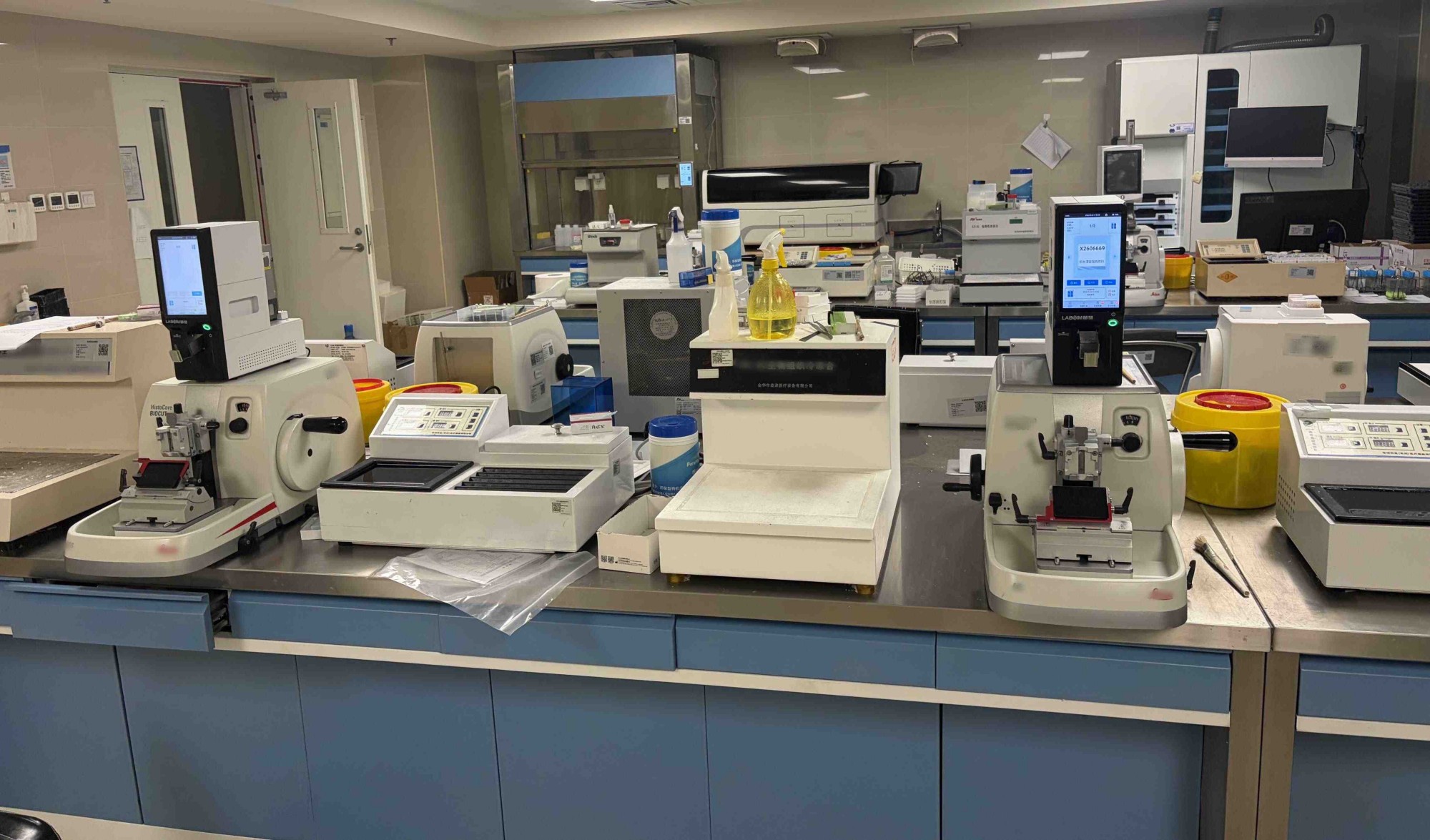
Automated slide and cassette labeling drastically eliminates manual handwriting operations, effectively reducing the risk of specimen misidentification and errors. It enables full-process traceability of pathological specimens and serves as a core efficiency-boosting solution for pathology laboratories.
The Labsim Pathology Printer is a professional identification printing device specially designed for pathology departments. It consists of two core series: Slide Printer and Tissue Cassette Printer. It supports automated numbering and full-process traceability for specimens in anatomical pathology and cytopathology scenarios.
Core Advantages
1. Manual Handwriting Replacement
Equipped with intelligent slide printers and tissue cassette printers, the device directly prints clear text and barcodes on specimens. The printed marks feature excellent scratch resistance and chemical resistance against various solution immersions, completely avoiding blurred handwriting and human-induced labeling errors caused by manual operation.
2. Batch Automatic Operation
The printer can load hundreds of slides or tissue cassettes at one time and complete automatic batch printing without manual on-site supervision. It greatly solves the inefficiency of traditional manual scanning and piece-by-piece printing, significantly improving laboratory throughput.
3. Seamless System Integration
It can be seamlessly connected with laboratory information systems such as LIS. Specimen data is automatically acquired from the system for one-click printing, minimizing manual data entry and intermediate operational links to reduce human errors.
4. Automatic Specimen Binding
Combined with the specimen management system, the barcodes on slides and tissue cassettes can be automatically associated with corresponding case information. Manual one-by-one binding is no longer required, which comprehensively optimizes the whole pathological workflow and improves overall operational efficiency.
Implementation & Equipment Selection Suggestion
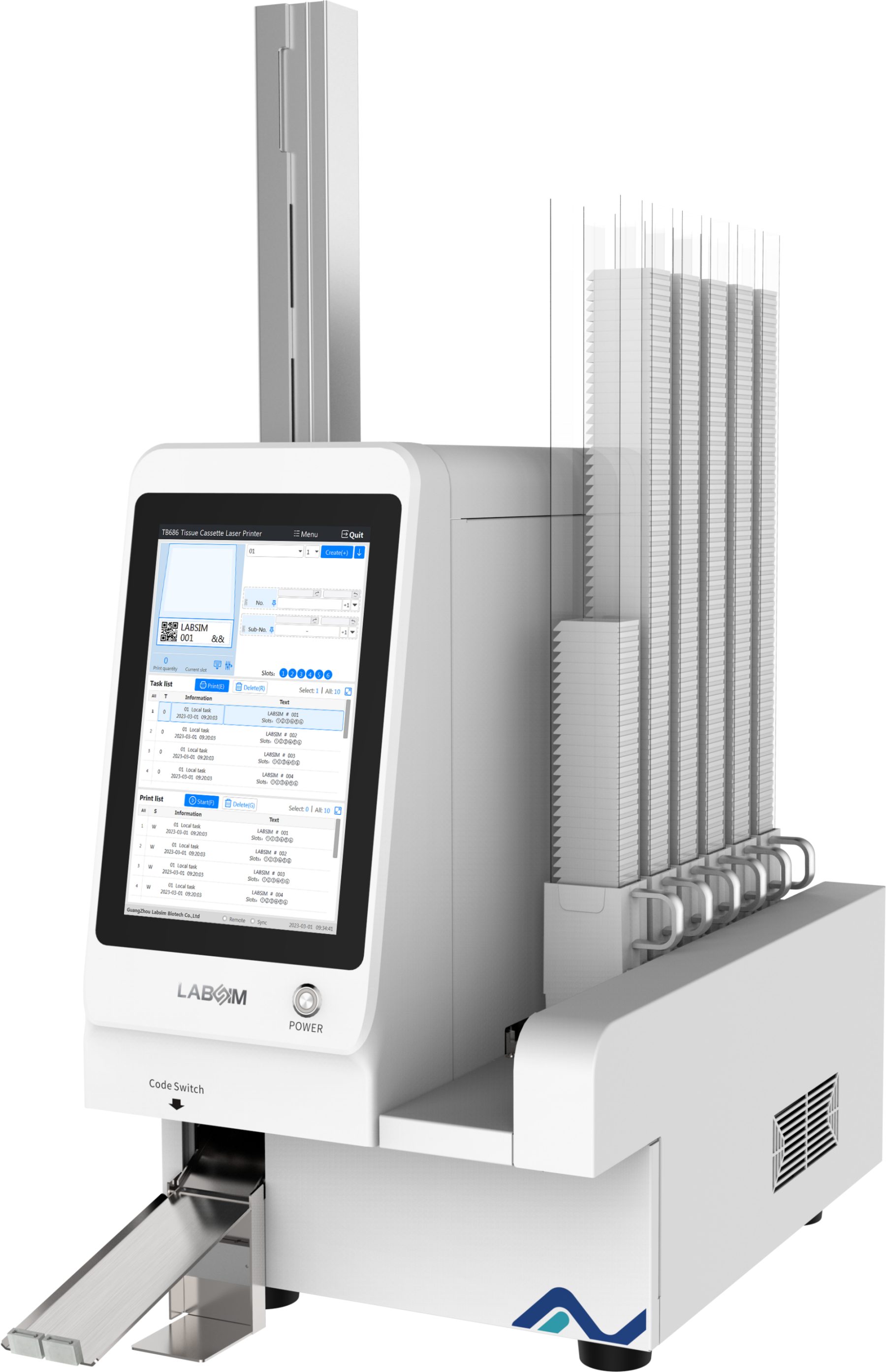
Select the appropriate printer model according to the daily specimen volume of the laboratory. For instance, the Labsim TB686 Tissue Cassette Laser Printer integrates high-resolution UV laser printing technology, automated cassette handling functions and flexible system compatibility, delivering stable and high-efficiency operation for standardized pathology workflows.
Why choose TB686?
🔹 Clear, high-resolution printing at up to 2500 dpi
🔹 Resistant to xylene, alcohol, and decalcifying fluid
🔹 Consumable-free, non-contact UV laser technology
🔹 Six loading slots for flexible batch processing
🔹 Compatible with LIS, HIS, PIS, and PACS systems
🔹Print without integration headaches.
Connect via Windows driver, PrintNet folder, serial, Wi‑Fi, or Ethernet.
🔹Supports end-to-end sample traceability, helping to reduce the risks of labeling errors, missed labeling, and mislabeling.
Why choose G306U?
🔹 Printed characters are resistant to a wide range of laboratory chemical reagents; waterproof, scratch-resistant, and fade-resistant, suitable for long-term storage and archival management.
🔹 Supports end-to-end sample traceability, helping to reduce the risks of labeling errors, missed labeling, and mislabeling.
🔹 Compact Footprint. Seamless Workflow Integration.
Fits easily into existing grossing and histology workstations.
🔹 Print without integration headaches.
Connect via Windows driver, PrintNet folder, serial, Wi‑Fi, or Ethernet.
🔹 Supports a multilingual interface, for example English, Spanish, Arabic, French, Korean, and Turkish.
Slide printing and cassette printing play different roles
Slide printers and tissue cassette printers are critical devices for digital and automated management in pathology laboratories. Although both belong to the specimen identification system, they differ in application stages, functional priorities and operating scenarios. Below is a detailed introduction for various use cases:
Tissue Cassette Printer: Identity Assignment at the Front-End of Grossing and Slide Preparation
Tissue cassette printers are mainly deployed at the front end of the pathology workflow, namely during tissue grossing and paraffin embedding. Their core function is to assign a unique digital identity to raw tissue specimens and guarantee traceability throughout all subsequent processing steps.
1. Application Scenarios
- Pathology Grossing Room: When pathologists section resected surgical specimens and select tissue fragments, information must be printed on tissue cassettes immediately. This scenario features high specimen volume and diverse sample types, requiring equipment with high-speed batch processing capability.
- Embedding Room: Before tissue blocks are embedded in paraffin, operators verify that the information on cassettes matches the tissue samples. The printer shall be compatible with tissue cassettes of different brands, angles (35° or 45° inclined surface), lidded and lidless types.
- High-Throughput Screening Centers: For laboratories handling hundreds or even thousands of specimens daily, fully automatic tissue cassette printers use robotic arms to pick, print and sort cassettes, enabling unattended operation and substantially cutting labor costs.
2. Core Requirements and Technical Features
- Chemical Resistance: Tissue cassettes undergo dehydration, clearing and infiltration with harsh chemicals such as xylene, alcohol and formalin. Therefore, printers must adopt special inks or thermal transfer technology to ensure printed marks do not fade or peel after prolonged chemical immersion.
- Large Capacity and Automation: Typical models can hold up to 480 tissue cassettes, support continuous batch printing and come with automatic collection function to avoid sequence errors caused by manual sorting.
- Information Interfacing: Seamless integration with LIS (Laboratory Information System) to directly retrieve patient data and barcodes/QR codes, reducing errors from manual data entry.
Slide Printer: Precision Marking at the Back-End of Sectioning and Diagnosis
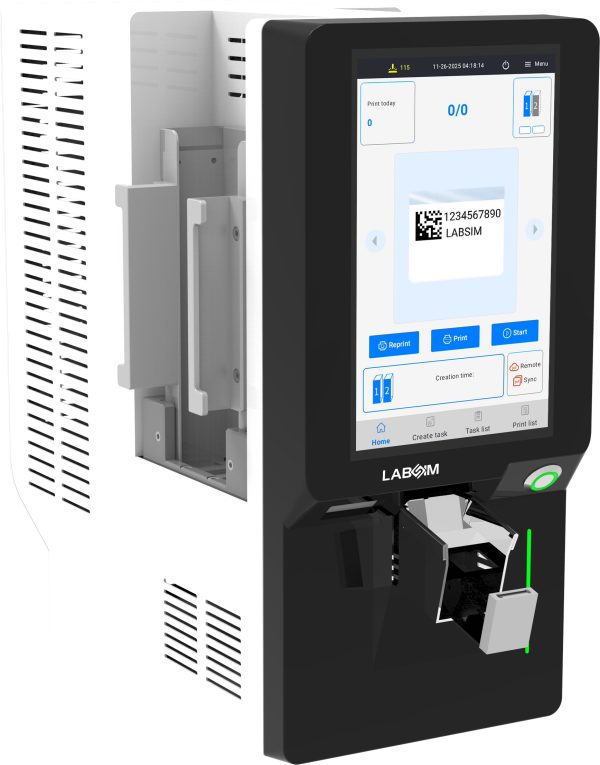
Slide printers are mainly used at the back end of the pathology workflow, covering paraffin sectioning, staining and microscopic diagnosis. Their core task is to accurately transfer information from embedded tissue blocks onto microscope slides for pathologists’ microscopic examination.
1. Application Scenarios
- Sectioning Room: After technicians cut thin sections from paraffin blocks and mount them onto glass slides, identifiers need to be printed on slides right away. This scenario calls for compact and flexible equipment that can be placed beside microtomes for on-demand operation.
- Cytology Laboratory: For marking slides of cervical smears, body fluid cytology and other cytological specimens. Since cytology slides are usually thin and fragile, the printer needs a gentle feeding mechanism to prevent slide breakage.
- IHC / Special Staining Area: Clear identification of every slide is required before complex staining procedures. Some high-end models support color printing to distinguish different staining batches or experimental groups.
- Research and Genetic Laboratories: For slide marking in high-precision experiments such as gene sequencing and fluorescence in situ hybridization (FISH), demanding high printing resolution and easily scannable barcodes.
2. Core Requirements and Technical Features
- High Precision and Clarity: Glass slides have smooth surfaces. Printed content must be fine and sharp, generally requiring a resolution of 300 dpi or higher to ensure readability of miniature QR codes and dense text.
- Resistance to Physical Abrasion and Washing: Slides go through repeated washing, drying and coverslipping during staining. The printed marks must withstand physical friction and water flow.
- Flexibility for Small-Batch Jobs: Compared with cassette printing, slide printing often involves on-demand printing of single or a small number of specimens. The equipment shall support quick startup, single-slide printing and compatibility with various slide sizes including coated slides.
- Integrated Design: Modern slide printers are often equipped with built-in scanners and display screens, supporting one-stop workflow: scan paraffin block barcode → auto-print slide labels, further eliminating risks of human error.
Labsim Integrated Slide & Cassette Printing Solution.Eliminate manual labeling errors and boost your histology lab efficiency with one unified system. As a professional brand with over ten years of deep expertise in intelligent pathologyprinters, we prioritize real clinical demands and follow lean manufacturing standards.Labsim offers a full range of pathology printers adopting UV/infrared laser andthermal transfer technologies. These compact, reliable, and feature-rich devices aredesigned to support diverse clinical applications, helping laboratories build efficientdigital pathology workflows and full-process quality control systems.