

Understanding the Differences Between Quantitative and Qualitative Point-of-Care Tests
Point-of-care testing, referred to as POCT, is characterised by testing performed close to the patient, simple operation and rapid result availability. It eliminates the process of sending samples to a central laboratory and is widely used in emergency departments, hospital wards, community clinics, physical examination centres, pre-hospital emergency care and primary medical institutions. Within the POCT system, tests are mainly divided into qualitative and quantitative categories based on output formats. Distinct differences exist between the two in interpretation logic, result implication, clinical application and quality control requirements. These are fundamental concepts that need to be clarified for clinical practice, reagent registration, bidding selection and in-hospital quality management.
I. Qualitative Point-of-Care Testing
- Test objective: To determine whether the target analyte is present in the sample; it only answers "present or absent".
- Result format: Positive / Negative, without specific concentration values. Some semi-quantitative products use grading notations such as +, ++, +++, which only indicate approximate ranges. A cut-off value is preset in the assay system. The result is positive if the analyte concentration exceeds the threshold, and negative if it falls below the threshold.
- Interpretation method: Lateral-flow colloidal gold technology is mostly adopted. Results are mainly interpreted visually by observing line colour development, and supporting instruments are not required in most cases for easy operation.
- Key performance indicators: Sensitivity and specificity are the core assessment indicators, focusing on accurate analyte detection and control of false-positive and false-negative results.
- Advantages: Low reagent cost, simple operation and fast turnaround time, suitable for large-scale preliminary screening and rapid rule-out.
- Limitations: A positive result does not indicate concentration level. Analyte levels can vary greatly between two positive samples. It cannot track changing trends of indicators and is not applicable for therapeutic evaluation or disease stratification.
- Typical examples: Urine pregnancy test strips, respiratory antigen test cassettes, faecal occult blood screening strips and rapid toxicology screening test strips.
II. Quantitative Point-of-Care Testing
- Test objective: To measure the exact concentration of the target analyte in the sample and answer "how much is present".
- Result format: Numeric outputs with units, e.g. CRP 7.5 mg/L, blood glucose 5.3 mmol/L, troponin 0.06 ng/mL, which can be interpreted against reference intervals.
- Interpretation method: Electrochemical or optical sensors capture reaction signals, which are converted into concentrations via calibration curves. Dedicated matching instruments are mandatory for reading.
- Key performance indicators: Besides sensitivity and specificity, precision, trueness, linear range and limit of quantitation shall be verified. Results are required to be metrologically traceable.
- Advantages: Values allow cross-comparison, and repeated retesting enables monitoring of dynamic changes to support risk stratification, therapeutic follow-up and medication adjustment.
- Limitations: Higher costs for instruments and reagents. Regular calibration and internal quality control are required, with higher standardisation requirements for operators.
- Typical examples: Portable blood glucose meters, POCT blood gas analysers, quantitative CRP assays, procalcitonin assays, glycated haemoglobin assays and D-dimer analysers.
III. Differences in Quality Control and Administration
Qualitative testing: Quality control mainly focuses on batch-to-batch reagent stability to reduce subjective bias from visual interpretation; operator training requirements are minimal. Quantitative testing: Classified as metrological testing, it follows management standards similar to routine laboratory tests. Instruments require periodic calibration and comparison testing; results are not reportable when quality control fails.
IV. Principles for Clinical Selection
- Neither type is superior to the other; their application scenarios are complementary. Qualitative assays are suitable for preliminary screening, while quantitative assays are used for confirmation, risk stratification and long-term monitoring.
- Many biomarkers are available in both qualitative reagent formats and quantitative platforms, such as hCG and procalcitonin. Qualitative cassettes may be used for rapid preliminary screening, whereas quantitative testing is mandatory when assessing changes in disease status.
Labsim POCT Immunoassay Analyzer
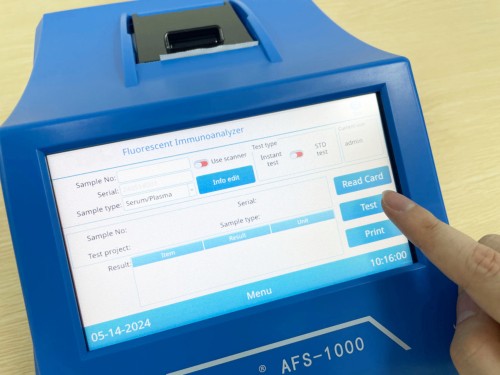
AFS-1000 Fluorescent Immunoanalyzer
This instrument is a single-channel entry-level dry fluorescent immunoassay platform. It features a compact structure and small footprint with favorable portability, suitable for low-volume testing scenarios including primary clinics, point-of-care emergency testing and mobile outreach screening. Centered on cost performance, it is ideal for medical institutions with limited budgets and sporadic low-volume testing demands. The instrument does not support parallel incubation or automatic sample addition; manual sample loading and test cartridge placement are required.
L300 Immunofluorescence Analyzer
The L300 is Bluelab’s new-generation single-channel dry immunofluorescence analyzer, an upgraded successor to the AFS‑1000. It retains the single-channel testing architecture while delivering systematic optimizations in human-machine interaction and operational experience. Equipped with the Android operating system and an 8.1-inch high-definition touchscreen, it adopts a redesigned intuitive UI for streamlined operation. Maintaining a lightweight form factor, it comes with an integrated waste cartridge storage compartment for automatic waste cartridge collection after testing, which reduces biohazard contamination risks and simplifies bench workflows. Its calibrated optical detection unit enables rapid signal interpretation.
The L300 has a built-in thermal printer and supports external printers. It is equipped with barcode scanning, USB data export and LIS connectivity, and supports multi-language interfaces to meet export project requirements. It still requires manual sample addition and cartridge loading without multi-channel parallel incubation, making it suitable for community clinics, emergency point-of-care testing and small medical facilities.
AFS2100S Multichannel Fluorescent Immunoanalyzer
The AFS2000S is a semi-automatic fluorescent immunoassay analyzer with 12 independent constant-temperature incubation channels. It targets primary medical institutions with moderate sample volumes and concurrent multi-assay testing needs, such as community health centers, general practice clinics, fever clinics and routine physical examination sites. It is configured with 12 thermally independent incubation channels with separate temperature control. Different assays can be initiated on demand without waiting for prior tests to finish, which flexibly adapts to randomly submitted samples. Its enclosed incubation chamber minimizes aerosol spread and improves intra-batch test repeatability. As a semi-automated platform, it relies on manual sample pipetting and cartridge loading and has no automatic piercing sampling or continuous track sampling structure. It resolves the queueing limitation of single-channel instruments at a moderate investment cost.
AFS2600B Immunofluorescence Analyzer
The AFS2600B is a compact track-based fully automated dry fluorescent immunoassay system. It is designed for township central hospitals, secondary hospital emergency departments and specialized clinics that demand automation with moderate daily sample throughput. Powered by the Android system and fitted with a 10.1-inch large touchscreen, it delivers a superior user experience and supports 4G transmission for seamless integration with hospital LIS and HIS systems. It incorporates reagent cartridge verification to alert operators of mismatched cartridges and mitigate human error. Among fully automated analyzers, it features a relatively small footprint with low site requirements and moderate overall investment. This fully automated system is well suited for outpatient departments and small medical facilities.
AFS3000 Automatic Fluorescence Immunoassay Analyzer
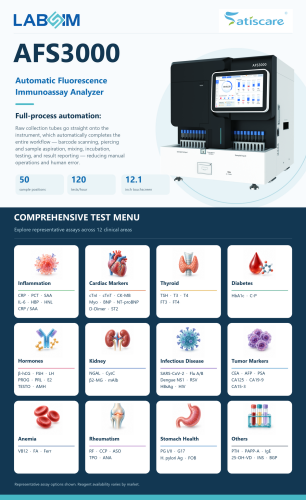
The AFS3000 is Bluelab’s flagship high-throughput track-based fully automated analyzer on the fluorescent POCT platform. It is developed for high-workload settings including county-level general hospitals, tertiary hospital outpatient departments, independent clinical laboratories and large-scale physical examination centers. It achieves a throughput of up to 120 tests per hour and supports continuous rack sampling; additional samples can be loaded online without halting ongoing runs. It is equipped with 50 sample positions, zoned incubation modules and 5 large-capacity reagent cartridge magazines, each holding up to 45 cartridges. Built-in RFID reagent management enables reagent traceability and inventory monitoring. Integrated functions include sample mixing, barcode identification, piercing sampling and liquid level sensing. It is compatible with regular blood collection tubes, swab tubes, stool sample containers and other vessel types, and supports two-step dilution assays to accommodate complex panel tests such as cardiac markers, inflammatory indicators, thyroid function and infectious disease combination panels.
Labsim POCT Test kits
Labsim All analyzers are built on a unified dry fluorescent immunoassay technology platform with interchangeable reagent cartridges. The full menu of POCT markers is supported, including Inflammation, Sex Hormone, Thyroid Hormone, Growth Hormone, Cardiac Marker, Kidney, Diabetes, Tumor Markers, Infectious Disease, Stomach Health, Anaemia, Nerve, Rheumatism and other analytes. The whole series adopts consistent quality control protocols and data communication standards for seamless LIS/HIS integration, facilitating centralized hospital informatization management. The platform also meets regulatory compliance and multi-language requirements for overseas export projects.