

What Factors Affect the Accuracy of Point of Care Testing?

POCT, or Point-of-Care Testing, refers to medical testing performed beside the patient with rapid turnaround of results. Featuring simple operation and short testing time, it eliminates the need for sophisticated laboratory equipment. It is widely adopted in emergency departments, outpatient clinics, home testing and community screening.
In clinical practice, some customers report inconsistent test results. Such inaccuracies are not necessarily caused by instruments or reagents. The accuracy of the POCT system is affected by a variety of interrelated factors, including instrument performance, sample quality, operating standardization, environmental conditions and reagent stability. Systematic management is therefore required to guarantee reliable test results.
I. Instrument-related Factors
This does not inherently mean instrument defects. For instance, the Labsim dry fluorescent immunoassay analyzer boasts solid technical accumulation over years and delivers stable performance. Nevertheless, instruments without regular calibration or standardized maintenance are prone to systematic deviations in routine use. Certain devices require calibration with dedicated test strips.
II. Sample Collection and Handling
- Sample type: Different analytes require specific sample matrices such as whole blood, serum and urine. For example, capillary blood samples may be contaminated by tissue fluid, which can interfere with coagulation test results.
- Sample volume and storage: Insufficient sample volume leads to test failure. Hemolysis and lipemia may interfere with optical detection. Some assays must be performed immediately after sampling to prevent analyte degradation.
III. Operational Factors
- Standardization of operation: Some operators are not laboratory professionals or fail to follow standard operating procedures. Improper sample loading volume and inadequate mixing of reagents, for example, may give rise to anomalous results.
- Limited capability to identify abnormal results and inconsistent awareness of quality control: Some operators may overlook relevant interfering factors.
IV. Environmental Interferences
- Temperature and humidity: Most POCT reagents should be stored at 2–30°C. High temperatures may denature reagents while low temperatures may cause moisture damage to test strips. Humidity above 80% can impair the reaction efficiency of test strips.
- Altitude and electromagnetic interference: Pressure variations at high altitudes may affect blood gas results. Strong electromagnetic fields (near large-scale equipment, for example) may disrupt instrument signals.
V. Reagents and Consumables
- Batch-to-batch variation: Minor differences in reaction efficiency may exist between reagent lots, which shall be verified via quality control.
- Expiry management: Expired reagents show reduced enzyme activity or antibody titer, potentially causing false-negative or false-positive results. Opened test strips are susceptible to environmental degradation if not used promptly.

VI. Quality Control Measures
- Internal Quality Control (IQC): Regular testing with quality control materials is required to verify system stability, especially after reagent lot changes or instrument maintenance.
- External Quality Assessment (EQA): Participation in external proficiency testing helps identify systematic errors and optimize workflows.
The above covers categorized influencing factors. In practical use of POCT analyzers and reagents, troubleshooting shall be conducted case-by-case based on actual issues. Testing shall be performed in strict accordance with instrument and reagent SOPs to achieve more accurate results.
Labsim POCT Immunoassay Analyzer
AFS-1000 Fluorescent Immunoanalyzer
This instrument is a single-channel entry-level dry fluorescent immunoassay platform. It features a compact structure and small footprint with favorable portability, suitable for low-volume testing scenarios including primary clinics, point-of-care emergency testing and mobile outreach screening. Centered on cost performance, it is ideal for medical institutions with limited budgets and sporadic low-volume testing demands. The instrument does not support parallel incubation or automatic sample addition; manual sample loading and test cartridge placement are required.
L300 Immunofluorescence Analyzer
The L300 is Bluelab's new-generation single-channel dry immunofluorescence analyzer, an upgraded successor to the AFS‑1000. It retains the single-channel testing architecture while delivering systematic optimizations in human-machine interaction and operational experience. Equipped with the Android operating system and an 8.1-inch high-definition touchscreen, it adopts a redesigned intuitive UI for streamlined operation. Maintaining a lightweight form factor, it comes with an integrated waste cartridge storage compartment for automatic waste cartridge collection after testing, which reduces biohazard contamination risks and simplifies bench workflows. Its calibrated optical detection unit enables rapid signal interpretation.
The L300 has a built-in thermal printer and supports external printers. It is equipped with barcode scanning, USB data export and LIS connectivity, and supports multi-language interfaces to meet export project requirements. It still requires manual sample addition and cartridge loading without multi-channel parallel incubation, making it suitable for community clinics, emergency point-of-care testing and small medical facilities.
AFS2100S Multichannel Fluorescent Immunoanalyzer
The AFS2000S is a semi-automatic fluorescent immunoassay analyzer with 12 independent constant-temperature incubation channels. It targets primary medical institutions with moderate sample volumes and concurrent multi-assay testing needs, such as community health centers, general practice clinics, fever clinics and routine physical examination sites. It is configured with 12 thermally independent incubation channels with separate temperature control. Different assays can be initiated on demand without waiting for prior tests to finish, which flexibly adapts to randomly submitted samples. Its enclosed incubation chamber minimizes aerosol spread and improves intra-batch test repeatability. As a semi-automated platform, it relies on manual sample pipetting and cartridge loading and has no automatic piercing sampling or continuous track sampling structure. It resolves the queueing limitation of single-channel instruments at a moderate investment cost.
AFS2600B Immunofluorescence Analyzer
The AFS2600B is a compact track-based fully automated dry fluorescent immunoassay system. It is designed for township central hospitals, secondary hospital emergency departments and specialized clinics that demand automation with moderate daily sample throughput. Powered by the Android system and fitted with a 10.1-inch large touchscreen, it delivers a superior user experience and supports 4G transmission for seamless integration with hospital LIS and HIS systems. It incorporates reagent cartridge verification to alert operators of mismatched cartridges and mitigate human error. Among fully automated analyzers, it features a relatively small footprint with low site requirements and moderate overall investment. This fully automated system is well suited for outpatient departments and small medical facilities.
AFS3000 Automatic Fluorescence Immunoassay Analyzer
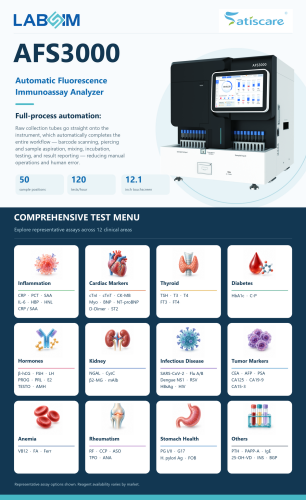
The AFS3000 is Bluelab’s flagship high-throughput track-based fully automated analyzer on the fluorescent POCT platform. It is developed for high-workload settings including county-level general hospitals, tertiary hospital outpatient departments, independent clinical laboratories and large-scale physical examination centers. It achieves a throughput of up to 120 tests per hour and supports continuous rack sampling; additional samples can be loaded online without halting ongoing runs. It is equipped with 50 sample positions, zoned incubation modules and 5 large-capacity reagent cartridge magazines, each holding up to 45 cartridges. Built-in RFID reagent management enables reagent traceability and inventory monitoring. Integrated functions include sample mixing, barcode identification, piercing sampling and liquid level sensing. It is compatible with regular blood collection tubes, swab tubes, stool sample containers and other vessel types, and supports two-step dilution assays to accommodate complex panel tests such as cardiac markers, inflammatory indicators, thyroid function and infectious disease combination panels.
Labsim POCT Test kits
Labsim All analyzers are built on a unified dry fluorescent immunoassay technology platform with interchangeable reagent cartridges. The full menu of POCT markers is supported, including Inflammation, Sex Hormone, Thyroid Hormone, Growth Hormone, Cardiac Marker, Kidney, Diabetes, Tumor Markers, Infectious Disease, Stomach Health, Anaemia, Nerve, Rheumatism and other analytes. The whole series adopts consistent quality control protocols and data communication standards for seamless LIS/HIS integration, facilitating centralized hospital informatization management. The platform also meets regulatory compliance and multi-language requirements for overseas export projects.